Access Control Systems vs Traditional Locks for Singapore Offices
Evaluating Access Control Systems vs Traditional Locks for Singapore Offices remains a top priority for facility managers.
We regularly guide directors through this exact dilemma.
Both approaches have genuine strengths. The right choice depends on your specific operational needs rather than simply chasing the newest technology.
As a professional locksmith in Singapore, our service team has installed both traditional commercial locks and modern access control systems across hundreds of offices, while also managing daily emergency lockouts for local homeowners and drivers.
This guide will compare the exact costs, maintenance realities, and specific use cases for each setup.
Traditional Lock Systems: The Fundamentals
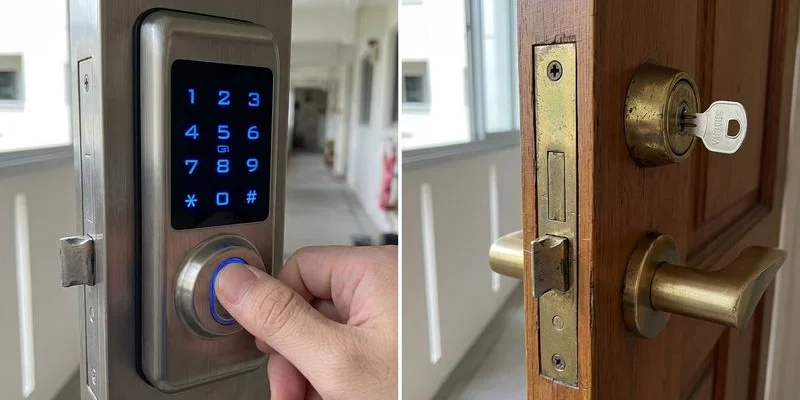
Traditional locking mechanisms have secured premises for centuries. These options include heavy-duty mortise sets, standard deadbolts, and simple padlocks. They operate on purely mechanical principles without requiring a power source or network connectivity.
Our engineers frequently maintain these reliable setups in heritage shophouses and older industrial estates. These foundational locks provide excellent baseline security.
Strengths of Traditional Locks
Mechanical locks offer distinct advantages for specific commercial applications.
- No power dependency: They continue working seamlessly during localized power outages.
- Low upfront cost: A quality commercial deadbolt from brands like Yale or Schlage costs $100 to $250 installed.
- High durability: A well-made ASSA ABLOY mortise lock can easily last over a million cycles with basic care.
- Simple fire compliance: Mechanical latches easily meet SCDF SS 332 fire safety standards without the need for complex electrical wiring.
- No ongoing fees: You only pay for occasional lock repair or routine servicing.
We highly recommend these mechanical options for clients focused on long-term simplicity. These benefits make traditional hardware highly attractive for small businesses.
Limitations of Traditional Locks
Purely mechanical security does present several operational challenges.
- No audit trail: You have zero record of who entered a specific room or when an event occurred.
- Key duplication risks: Standard keys can be copied at any neighbourhood key duplication shop, requiring investment in expensive restricted keyways like Medeco to prevent unauthorized copying.
- Expensive lockouts: Lost keys require immediate rekeying to maintain security.
- Slow access revocation: Collecting physical keys from departing staff is tedious and prone to human error.
Our technicians frequently respond to urgent service calls simply because a single master key went missing. Physical hardware simply cannot match the agility of digital tracking.
Electronic Access Control: The Modern Approach
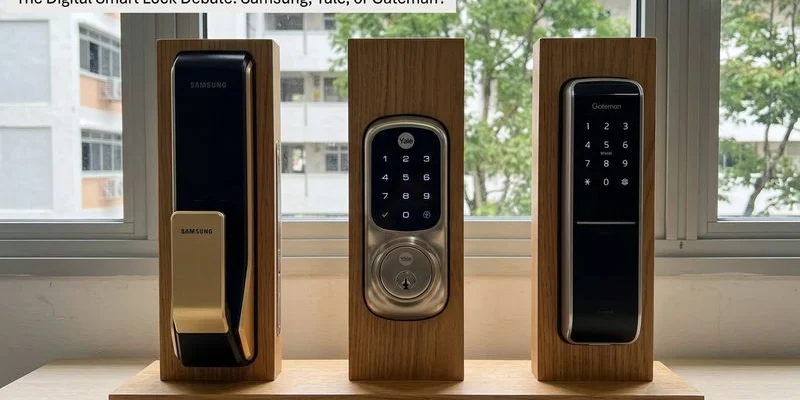
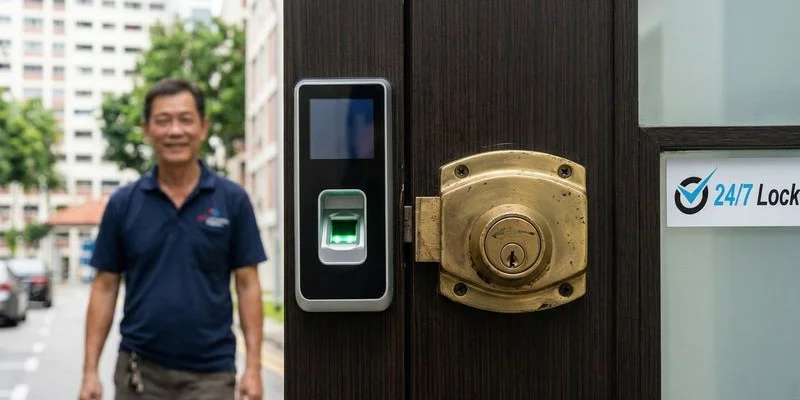
Electronic systems replace physical keys with digital credentials. These modern setups use RFID cards, mobile Bluetooth Low Energy signals, or biometric scanners. Our design team builds these networks to centralise your security management, allowing administrators to grant or revoke entry permissions instantly from a cloud dashboard.
Singapore is currently seeing a massive shift in authentication regulations. The Personal Data Protection Commission ruled that private organisations must phase out the use of NRIC numbers for authentication by the end of 2026. This legal change pushes many businesses to adopt secure mobile credentials or encrypted facial recognition systems instead.
Strengths of Access Control Systems
Digital security provides unparalleled visibility into your daily operations.
- Comprehensive audit trails: Every single entry is logged with a specific timestamp and user ID. The Monetary Authority of Singapore (MAS) TRM guidelines strictly mandate these audit logs for financial sector server rooms.
- Instant credential management: You can deactivate a lost card or a departed employee’s mobile access in seconds.
- Granular scheduling: Administrators can restrict warehouse entry to business hours or limit IT room access to specific maintenance windows.
- Remote lockdowns: Cloud platforms allow managers to secure the entire office from a smartphone application.
- Seamless integration: These networks easily connect with CCTV cameras and visitor management software.
We heavily rely on this remote management feature when assisting clients across multiple branch locations. This connectivity reduces the need for on-site security guards.
Limitations of Access Control Systems
Upgrading to digital readers requires careful planning to address infrastructure limitations.
- Higher initial investment: Hardware, wiring, and software setup for a 10-door office typically costs between $6,000 and $15,000.
- Strict fire code requirements: SCDF regulations dictate that electric locks on fire-rated doors must feature fail-safe mechanisms. You must install emergency green break-glass switches to ensure the doors unlock during a fire alarm.
- Battery maintenance: Power supply unit batteries degrade over time and require replacement every one to two years.
- Cybersecurity vulnerabilities: Any networked device carries a hacking risk if administrators fail to update the firmware or change default passwords.
Our maintenance contracts specifically focus on monitoring these vulnerabilities. Regular software updates are essential to keep these complex networks running securely.
Cost Comparison: Access Control Systems vs Traditional Locks for Singapore Offices
Financial planning requires looking beyond the initial installation quote.
We strongly encourage clients to calculate a five-year total cost of ownership before making a final decision.
| Cost Category | Traditional Locks | Access Control |
|---|---|---|
| Hardware per door | $100 to $250 | $500 to $2,000 |
| Installation (8 doors) | $400 to $800 | $2,000 to $5,000 |
| Total upfront | $1,200 to $2,800 | $6,000 to $21,000 |
| Annual maintenance | $200 to $500 | $500 to $2,000 |
| Key management | Manual (rekeying: $80 to $150 per lock) | Software ($50 to $200 per month) |
| 5-year total cost | $2,200 to $5,300 | $8,500 to $31,000 |
The apparent cost gap narrows significantly when you factor in administrative time. Spending $150 to rekey eight separate doors every time a manager resigns adds up rapidly in a high-turnover business.
When Traditional Locks Make More Sense
Physical keys remain the most logical choice in several specific commercial scenarios.
Our installation teams typically recommend mechanical options for these situations.
- Tight budgets: Small startups may struggle to justify a $10,000 upfront security expense.
- Simple layouts: A basic commercial unit with one main entrance and a single storeroom rarely needs complex software.
- Older infrastructure: Heritage buildings often lack the ceiling space required to conceal heavy wiring.
- Stable teams: A small group of long-term employees makes physical key tracking very manageable.
- Established hierarchies: A mechanical master key system provides structured, tiered entry permissions without any electronic components.
Mechanical security provides unmatched reliability for straightforward applications.
When Access Control Is Worth the Investment
Electronic networks quickly pay for themselves when operational complexity increases.
We see the fastest return on investment in dynamic corporate environments.
- Strict compliance needs: Legal firms and healthcare providers must maintain irrefutable entry logs to satisfy industry auditors.
- High staff turnover: Retail shops and co-working spaces save thousands of dollars by avoiding continuous lock replacements.
- Distributed operations: Managing several different branch locations from a single web dashboard saves countless hours of travel time.
- After-hours operations: Logging late-night entry protects the company from liability issues.
- Rapid scaling: Installing network cables during your initial office build-out prevents expensive retrofitting work later.
Digital infrastructure creates a secure foundation for any rapidly growing enterprise.
The Hybrid Approach
Many organizations find that a blended security strategy offers the best value. You do not need an expensive card reader on every single interior closet.
Our preferred layout secures the building perimeter electronically while keeping internal partitions mechanical.
- High-security zones: Main entrances, server racks, and finance departments receive digital readers to ensure strict logging.
- Low-risk areas: Break rooms, standard executive suites, and supply closets use high-quality deadbolts.
This targeted deployment concentrates your budget where tracking matters most. A standard two-door network controller easily handles the main entry points while keeping hardware costs reasonable.
Making Your Decision
There is no universally correct answer when comparing Access Control Systems vs Traditional Locks for Singapore Offices.
We evaluate your budget, staff size, and specific building layout before making any recommendations.
Call us at +65 8243 2440 or visit our page on access control systems to discuss the best physical security strategy for your space.
Need Locksmith Help?
Our team is available 24/7 for emergency lockouts and lock services across Singapore.
WhatsApp +65 8243 2440